Specification
Input count, string current, voltage class, enclosure, connectors.

Quote coordination
A solar combiner box manufacturer quotation is usable only after input count, string current, and delivered scope sit on the same sheet. BrightFlow Supply prepares that sheet for business buyers. It does not build the enclosure and it does not sign the interconnection.
The working set is one line, a short equipment list, or a wider bill of materials. Each line keeps its own input count. Combining two lines into one box because they share a voltage class is a buyer decision, not a default of this desk.
A family brochure is a catalog. It does not replace the file for the proposed item. ISO 9001, when a supplier offers it, is a quality-system document to read, not a product listing. UL or ETL evidence, where you need a US safety listing, has to name the model on the quote. This desk does not hold those files in advance.
Code review, structural attachment, and interconnection approval remain with the parties qualified for the project. A quotation that restates 600 V, 1000 V, or 1500 V maximum system voltage has answered a field. It has not accepted the array design. The responsible project designer supplies the string calculation and its conditions; the factory must acknowledge the requested value and identify any deviation.
Rated power in kilowatts describes the wider plant. It is useful context beside the box, and it is a poor substitute for string current in amperes. A 12-input enclosure and a 16-input enclosure are different lines, just as 10 A and 15 A string currents are different lines, and a 32-input 20 A request is a third line. If the inverter uses an MPPT window, note that window only as a downstream constraint. The combiner request does not set the inverter topology.
Communication requirements belong here when the box includes monitoring. Name the protocol you hope to see, then ask the supplier whether that protocol is on the quoted model. Silence in the brochure is an open item, not a no.
Three limits are part of the service. Stock is unknown until a supplier states it for the quoted line. Lead time on a family page is not a ship date for your quantity. A preference for premium, mid-range, or budget-friendly factories is your commercial posture, recorded with currency and a per-unit or whole-order budget if you choose to give one. It is not a ranking this desk has audited.
Input count, string current, voltage class, enclosure, connectors.
Same unit of measure on every returned quotation.
Freight, taxes, packaging, and accessories written in or marked excluded.
Files bound to the manufacturer and model on that quotation.
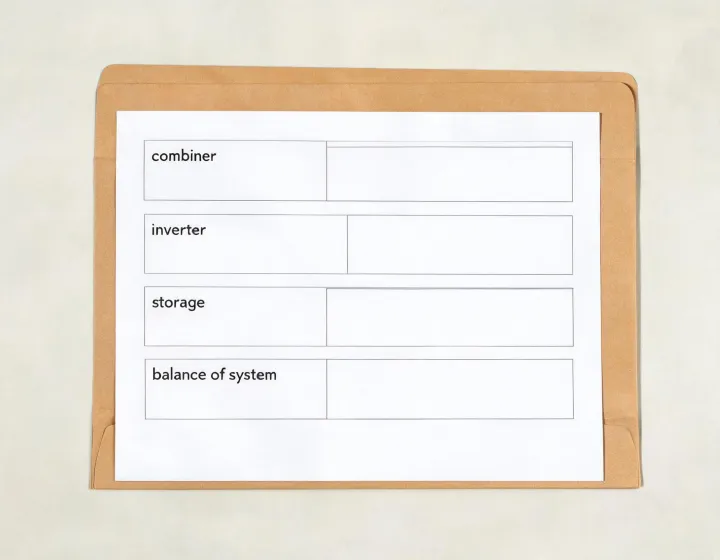
Unit price and delivered scope pull in different directions. A compact unit figure helps when every accessory and the freight basis match. It misleads when one offer includes copper whips and the other stops at the enclosure wall. Read both columns before you treat either number as the cost of the line. The Energy.gov component overview, consulted in the 2026-10-26 research set, only names the kinds of parts in a photovoltaic system. It is not a supplier list.
Bring product, quantity, destination, an optional budget basis, and your supplier preference. The next step is a factory quotation request, not a finished design.
Request Factory QuotesQualified business buyers
A confirmed benefit may be up to 3%.
Eligibility applies to qualified business buyers and is confirmed after we review your product, quantity, destination, and sourcing requirements.