Five project contexts
Commercial rooftop
Application: parapet or ballasted zones, often with short homeruns. Interface questions: outdoor enclosure rating, penetrations, and whether the disconnect is integral. RFQ unit: one box per roof zone, or a set if the zones differ.
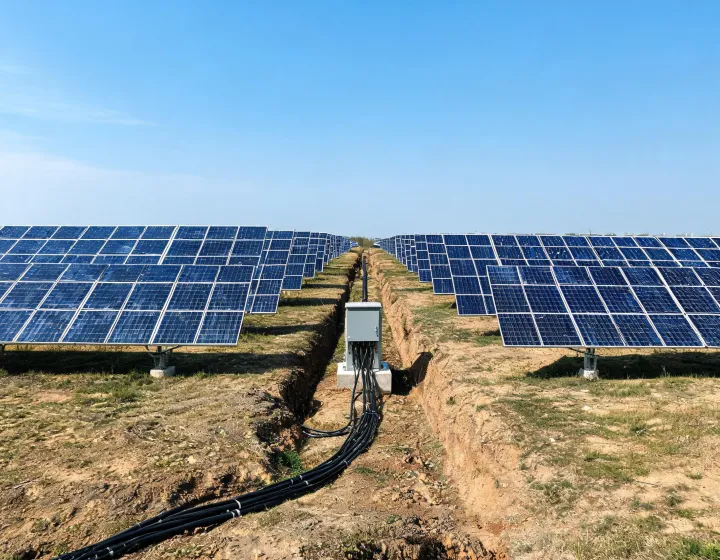
Ground-mount field
Application: row-end collection before the inverter pad. Interface questions: pedestal height, trench direction, and string current per row. RFQ unit: a project lot with each combiner position listed.
Storage neighbor
Application: PV collection near a battery container. Interface questions: which conductors are PV and which are storage. RFQ unit: the PV combiner only, unless a separate line names the storage equipment.
Fleet or site charging yard
Application: canopy PV that shares a site with chargers. Interface questions: whether the combiner output stops at the PV inverter. RFQ unit: canopy boxes, not the charger pedestals.
Industrial energy yard
Application: a plant load with an on-site array. Interface questions: existing switchgear tag, enclosure environment, and communication if monitoring is in scope. RFQ unit: the boxes the drawing actually shows.
Unit price and delivered scope on a project lot
Illustrative RFQ inputs, not completed-project results: a designer might request a 1,000 V ground-mount lot with 24 inputs and 15 A string current. A lower unit price helps acquisition cost when the specification and delivered scope match; a more complete delivered offer may reduce missing-accessory and freight uncertainty. Compare the same quantity, currency, connector kit, freight destination, duties, warranty and model-specific documents before choosing. A separate example might request 600 V, 12 inputs and 10 A, or 1,500 V, 32 inputs and 20 A. Maximum system voltage, string current and enclosure rating require separate checks; voltage class does not establish environmental suitability. The responsible designer provides the calculation basis. No percentage saving is calculated from these examples.
Central or string conversion and module-level microinverters are different architectures. The US Department of Energy component overview describes their cost, service and independent-operation considerations. For procurement, ask the project designer whether the drawing requires a DC combiner at all, and which circuits it collects. Do not transfer a DC combiner requirement to a microinverter system solely because both use PV modules.
AC-coupled versus DC-coupled storage is another neighboring split. If storage is DC-coupled, confirm whether any PV combiner also carries battery current. If it must not, say so. This page does not decide the coupling method. The Energy.gov component overview, read for the 2026-10-26 research notes, names photovoltaic parts. It does not choose either coupling for the yard.
Before award, give each proposed supplier the same revision of the position schedule and ask for a drawing, datasheet, enclosure evidence and applicable listing record naming its exact model. Record the document date, input count, string current in A, maximum system voltage in V, enclosure rating and cable-entry dimensions in a requirement/offer/deviation table. If a sample is needed, agree its cost, quantity, inspection method and acceptance reviewer before ordering. At receipt, compare the sample label, mounting dimensions and supplied documents with that table; record any mismatch and keep the line open until the responsible reviewer accepts it. Electrical testing and energization require qualified parties under an agreed procedure.